Active Projects
Click on the images below to find out more about each project!

Co-STAR: Supporting Special Education Teachers in Developing Positive Collaborative
Relationships with Paraprofessionals
(Funded by National Institute for the Advancement of Education)
We are analyzing data!

(Funded by U.S. Department of Education Office of Special Education Programs)
We are welcoming a new cohort of scholars!

(Funded by Clark County School District and Rodman Scholars Grant)
We are recruiting scholars!
(Funded by private partnership, through Nevada Community Foundation)
We are preparing to launch the study!

We are recruiting research participants!

Examining the Experiences and Perceptions of Pre-service Teachers in Using Generative AI
We are collecting data!

(Funded by Racial Equity & Social Justice Interdisciplinary Research Development Mini-Grant)
Completed Projects
Email catharine.lory@unlv.edu to request a copy of any article if you are unable to access it through the link provided.
Understanding Autism and Supporting Individuals with Autism



Empowering Practitioners and Researchers



Synthesizing Current Knowledge and Evaluating Strength of Evidence


Summary of Projects
Co-STAR: Supporting Special Education Teachers in Developing Positive Collaborative Relationships with Paraprofessionals
Population: Teachers and paraprofessionals who work with students emotional behavioral disorders
Summary: The purpose of this study is to provide and evaluate a series of professional development sessions to teacher-paraprofessional dyads in special education to learn the foundations of collaboration and practice building collaboration routines to change classroom practices. The project is co-led by Drs. Jabari Taylor, Catharine Lory, Heather Baltodano-Van Ness, and Alex Smith.

Funding: This project is funded by the National Institute for the Advancement of Education Research Fellowship Program.
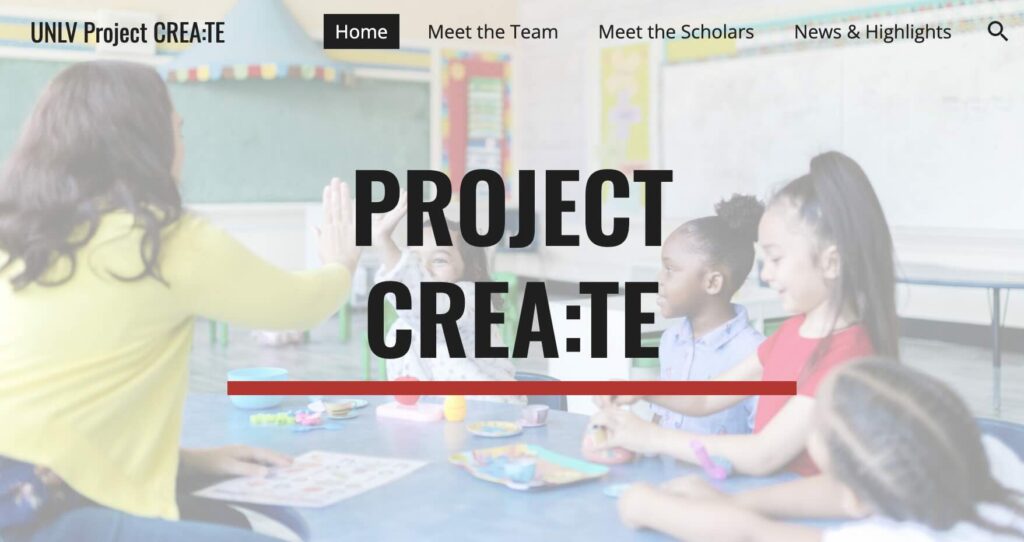
CREA:TE (Culturally Responsive Evidence-based practices in Autism: Teacher Empowerment)
We are welcoming our 3rd cohort of scholars!
Population: Current special education or elementary education teachers who are interested in pursuing endorsements in Autism and Early Childhood Special Education.
Summary: The program offered through Project CREA:TE has an emphasis on preparing teachers to engage in developmentally appropriate and culturally sustaining teaching practices with autistic students. The program includes rigorous coursework taught by highly qualified faculty in the Department of Early Childhood, Multilingual, and Special Education, supervised field experience over multiple semesters, mentorship from faculty and peers who are invested in the professional growth and well-being of Project CREA:TE scholars.
Meet our team: Drs. Catharine Lory, Alex Smith, Heather Baltodano-Van Ness, Jabari Taylor, Joseph Morgan. Meet our scholars. See our program updates to find out what we are up to!
Funding: This project is funded by the Office of Special Education Programs, U.S. Department of Education.
NCASE: Nevada Collaborative on Autism and STAR Endorsement
We are recruiting scholars!
Population: Current teachers interested to pursue certification in Autism or Emotional Behavioral Disorders (EBD).
Summary: This scholarship program offers an accelerated sequence of graduate level courses for currently licensed teachers to fulfill requirements for certification in Autism or EBD. This program is co-led by Drs. Joseph Morgan, Heather Baltodano-Van Ness, and Catharine Lory.
Funding: This project is funded by the Clark County School District and Rodman Scholars Grant.
SOCIAL-NV: Strengthening Outcomes in Communication, Interaction, and Language development in Nevada
Population: Children with neurodevelopmental conditions and complex needs in language development and social communication skills, their families, and service providers (e.g., speech and language therapists, behavior therapists).
Summary: This project is led by Dr. Lory, with the following aims: (1) examine the service needs in Nevada for families of children with neurodevelopmental conditions and complex needs in language development and social communication skills, and (2) design interventions and supports to remediate service gaps, and (3) provide recommendations for the state of Nevada to address service barriers and gaps.
Funding: This project is funded by a private partnership through Nevada Community Foundation.
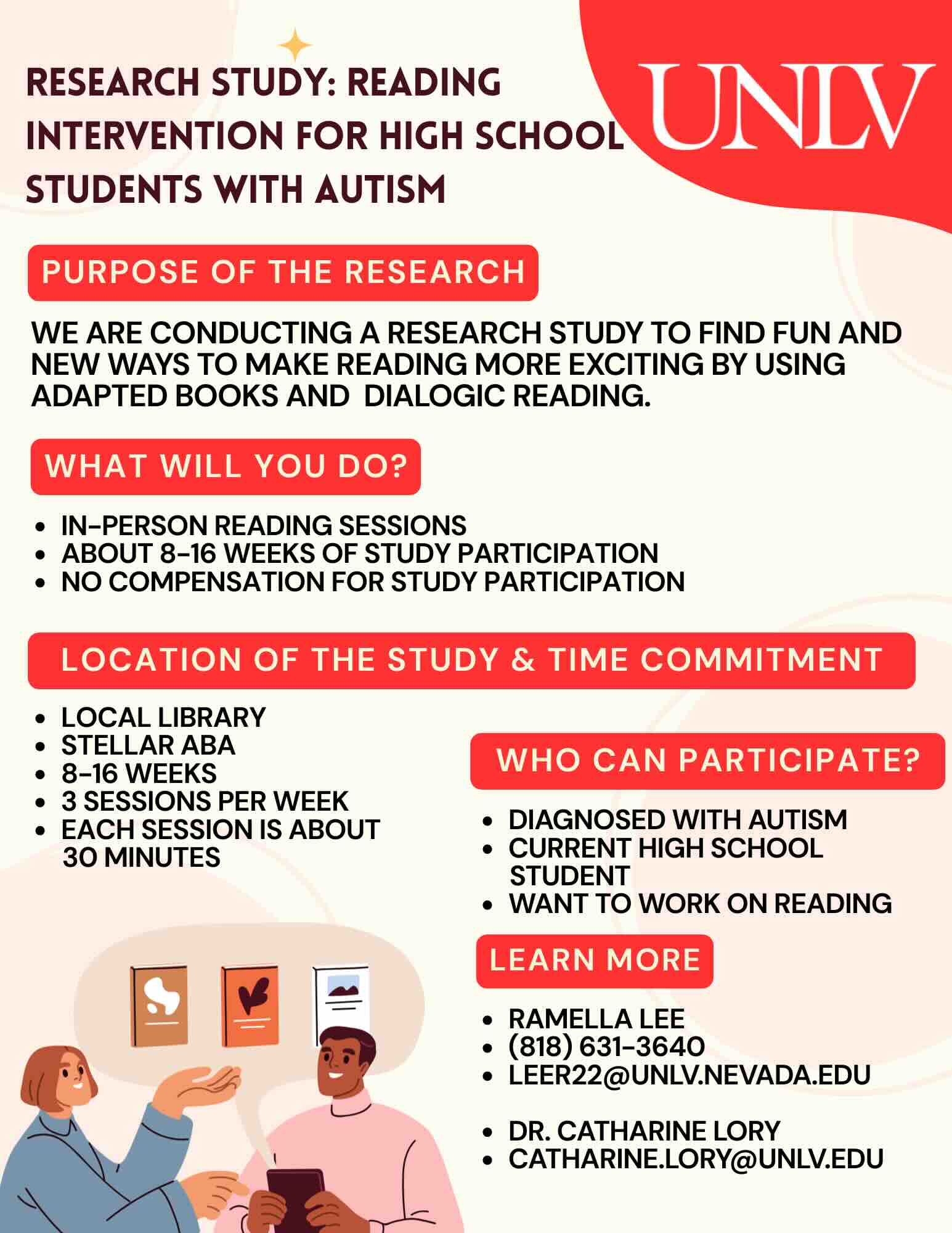
Reading Intervention for High School Students with Autism
Population: High school students with autism who need additional support in reading comprehension.
Research design: Single-case experimental design.
Summary: Doctoral candidate Ramella Lee developed a reading intervention consisting of dialogic reading and adapted reader and is evaluating its effect on the reading comprehension of high school students with autism.
Examining the Experiences and Perceptions of Pre-service Teachers in Using Generative AI
Population: Pre-service teachers across teacher education majors.
Research design: Qualitative analysis of semi-structured focus groups.
Summary: Doctoral student Fan Cao is conducting focus groups with pre-service teachers to investigate their experience in and what they think about using Generative AI for teaching purposes (e.g., lesson planning).
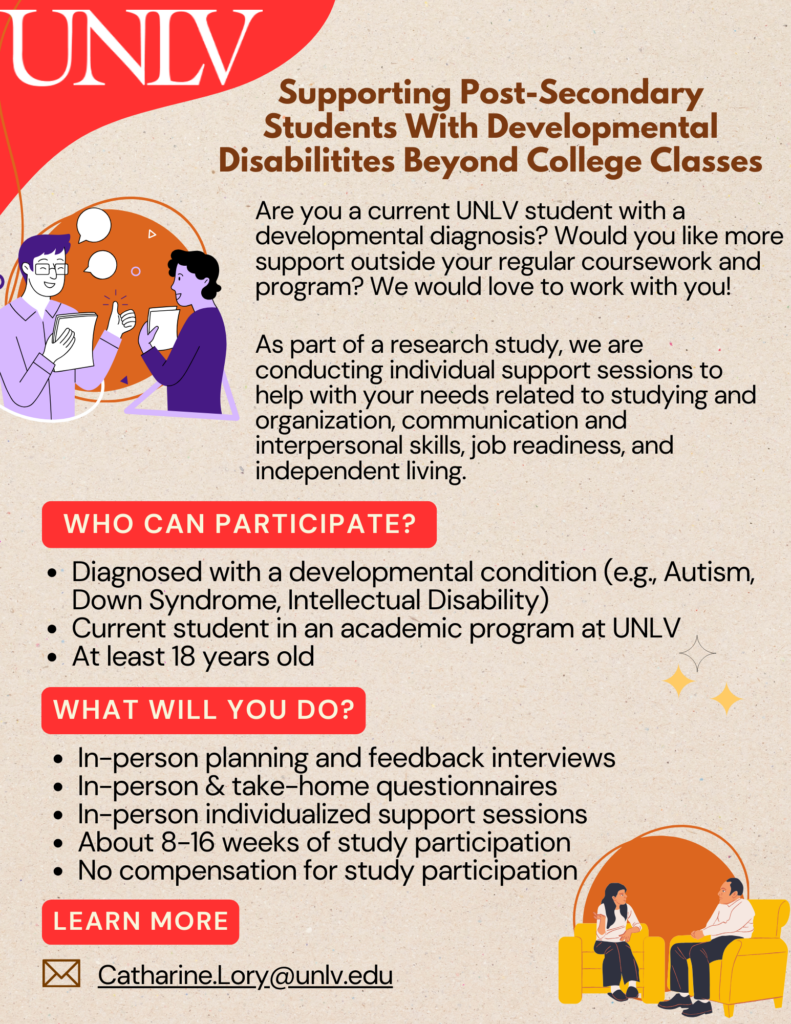
Supporting Postsecondary Students with Autism/Intellectual Disability Beyond College Classes
We are recruiting research participants!
Population: Postsecondary students with autism, intellectual disability, or other developmental disabilities, age 18 or older
Research design: Single-case experimental design
Summary: The purpose of this study is to support postsecondary students with autism, intellectual disability, or other developmental disabilities to learn new skills outside of their college classes. We may work on academic, organizational, social communication, independent living, or job skills, depending on the individual student’s priorities and preferences.
Identifying Educators’ Needs in Supporting Students with Autism
Population: Teachers of students with autism
Research design: Focus groups
Key findings:
- Teachers most frequently identified academics as their strength, citing familiarity with the content and teaching methods.
- Teachers most frequently reported difficulty with the behavioral domain due to significant student needs and limited training and resources.
- Top facilitators included collaboration with families and staff, availability of support personnel, and teacher confidence.
- Top barriers included inadequate training, staff support, and administrative support.
Comparing Recent Versions of What Works Clearinghouse Research Standards
Research design: Systematic literature review
Summary: What Works Clearinghouse (part of Institute of Education Sciences) published a revised set of standards for single-case research in 2022. Using a sample of the literature, we systematically applied versions 4.1 and 5.0 of the standards to the same sample of studies to identify critical differences in evaluation outcomes. More stringent evaluation criteria in version 5.0 resulted in different quality ratings across 27% of the sample. We encourage special education researchers to determine the best use of these standards based on the primary purpose of their work and recommend that scholars in the field more closely engage with our evolving research standards.
Interventions for Challenging Behavior of Autistic Students in General Education Settings: A Systematic Literature Review
Population: Students with autism, ages 3-21 years old
Research design: Systematic literature review
Summary: We synthesized existing research on school-based interventions that address the behavioral needs of students with autism in inclusive settings (i.e., where neurotypical peers are present). Our major findings include: (a) Related to participant characteristics, there was inadequate diversity in relation to disability, age, and race and ethnicity, (b) Related to intervention efficacy, interventions informed by functional behavioral assessment data consistently produced strong effects, (c) Related to researcher-practitioner collaboration, joint implementation of interventions was the most common method of collaboration across studies, with less studies involving practitioners in the development of interventions.
Exploring Subtypes of Repetitive Behavior in Children with Autism Through Functional Analysis and Wearable Technology: A Pilot Biobehavioral Assessment
Population: Children with autism, ages 4-7 years old
Research design: Single-case experimental design with visual analysis and nonparametric statistical analysis
Summary: We designed and piloted a biobehavioral assessment to (a) classify the repetitive behavior (i.e., repeated motor movements and vocalizations) of autistic children into subtypes and (b) determine if these external, observable behaviors are associated with internal neurophysiological activity (i.e., changes in heart rate as a measure of autonomic arousal). Clinic staff implemented a modified functional analysis with each child in their natural environment where they received ABA (applied behavior analysis) services. The children wore a digital wristband to measure their neurophysiological activity. Through this study, we found that autistic children’s repetitive behavior may occur in response to either too little or too much background noise, or both. We also found that heart rate variability is significantly associated with levels of repetitive behavior.
A Comparison of Heart Rate Variability between Children with Autism and Neurotypical Peers
Population: Children with autism, ages 9-15 years old
Research design: Matched-group design experiment
Summary: We examined differences in heart rate variability across two groups of children (21 children with autism and 21 neurotypical children) and found significantly lower heart rate variability in children with autism. As heart rate variability is an indicator of how well the autonomic nervous system is regulated, our study results suggest that dysregulation of the autonomic nervous system is present in children with autism.
Coaching a Special Education Teacher to Implement Systematic Instruction
Population: Special education teacher; elementary school students with learning and developmental disabilities
Research design: Single-case experimental design
Summary: We provided individualized coaching for an elementary school special education teacher, Aaron (pseudonym), to enhance his teaching practices with students across disability categories (autism, intellectual disability, learning disabilities, speech and language impairment, ADHD, etc.) In his resource classroom, Aaron taught reading, math, and social skills to students in grades 2-5. With the support of his coach, Aaron achieved his teaching goals and indicated that he would like to use the same coaching approach to support the paraprofessionals in his classroom.
“I had a lot of fun working on this, and it was very helpful for myself and my students! I hope to teach it to my paraprofessionals as well.”
— Aaron, elementary special education resource teacher
Addressing Challenging Behavior in Children with Autism Through Visual Activity Schedule and Instructional Choice
Population: Children with autism, ages 4-6 years old
Research design: Single-case experimental design
Summary: We developed an intervention that combines the use of a visual activity schedule and instructional choice to reduce escape-maintained challenging behavior (e.g., refusal to engage in instructional activities, tantrum, elopement) in children with autism. The visual activity schedule included four less-preferred instructional activities and the instructional choice involved choosing between two ways of completing an activity (e.g., write on the desk or on the floor). This antecedent-based intervention successfully reduced the children’s challenging behavior. Both children liked the intervention. Their support professionals also indicated that the intervention was acceptable and feasible to use in their service setting.
Challenging Behavior Interventions for Students with Developmental Disabilities in Inclusive School Settings: A Meta-analysis
Population: Students with developmental disabilities, ages 3-21 years old
Research design: Meta-analysis of single-case experimental studies
Summary: A strong overall effect was found across interventions that targeted the reduction of challenging behavior of students with developmental disabilities in inclusive settings (where typically developing peers are present). Behavior topography, type of interventionist, and some intervention components moderated the intervention effects.
Play Interventions Involving Children with Autism and Typically Developing Peers: A Systematic Review
Population: Pre-K children with autism
Research design: Systematic literature review of single-case experimental studies
Summary: Involving typically developing peers in interventions to teach play skills (e.g., functional play, symbolic play, etc.) to children with autism can yield positive outcomes. The quality of research on this topic may be improved, as only 3 out of 16 studies included for review met Council for Exceptional Children quality indicators.
